This post contains affiliate links. If you buy through them, we may earn a commission at no extra cost to you. Learn more.
Quick answer: To size a generator, add up the running watts of everything that stays on, then add the biggest extra demand you expect, such as one motor starting or a microwave switching on. That total is the starting (surge) watts to look for. For running watts, divide what you run at the same time by 0.8, so the generator is not working above 80% of its rating for hours. A typical home backup of a fridge, sump pump, furnace fan, lights, TV and microwave comes to about 5,700 W. Our generator wattage calculator below does the math for you.
Disclaimer: This calculator gives estimates for planning only. It is not electrical or safety advice. Use the wattage labels on your own appliances, follow the generator maker’s instructions, and have a licensed electrician install any transfer switch or interlock kit. Never connect a generator to house wiring any other way.
Generator Wattage Calculator
Tick the appliances you want to power, or start with a preset for home backup, an off-grid cabin, an RV or a workshop. Change the quantity and watts to match your labels, and tick “Occasional” for things you only use for a few minutes. The result updates as you go.
Loading the generator wattage calculator…
Running Watts vs Starting Watts
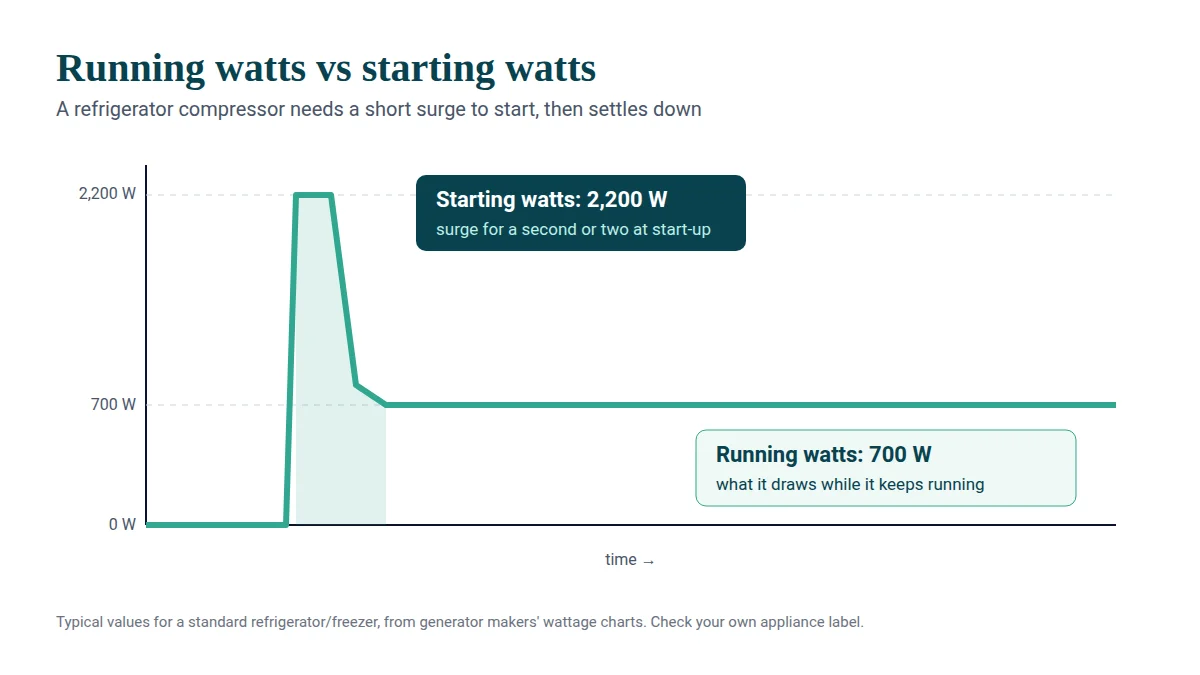
Every generator lists two numbers. Running watts (also called rated watts) is what it can supply hour after hour. Starting watts (surge or peak watts) is the short burst it can give for a second or two while a motor gets going.
Anything with a motor or compressor needs that burst. A standard fridge runs on about 700 W but needs around 2,200 W to start, according to Generac’s guide to starting watts. Lights, TVs, chargers, coffee makers and heaters need about the same watts to start as to run.
How to Calculate the Generator Size You Need
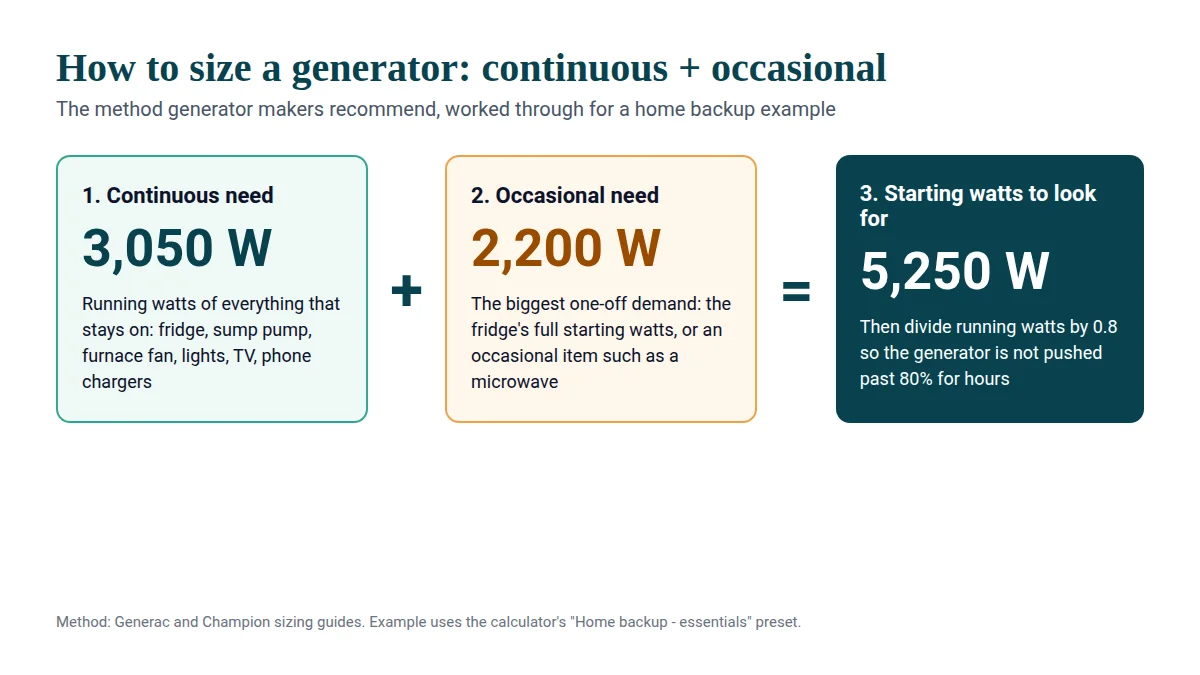
The calculator follows the sizing method that generator makers recommend, including Generac and Champion Power Equipment: add the running watts of what you run together, then add the biggest starting demand. You can do it by hand in four steps:
- List what stays on. Add the running watts of everything that runs for long stretches: fridge, freezer, sump or well pump, furnace fan, lights, TV, router and chargers. This is your continuous need.
- Find the biggest extra demand. This is either the full starting watts of your largest motor, or the biggest item you only use now and then, such as a microwave or hair dryer. Use whichever is larger. This is your occasional need.
- Add them together. Continuous need plus occasional need is the starting watts your generator should have.
- Leave headroom on running watts. Add the running watts of your largest occasional item to the continuous need, then divide by 0.8. This is the 20% cushion Champion recommends so the generator does not run flat out for hours. The calculator lets you change this load limit.
Why not just add every starting watt together? Motors do not all start at the same moment, so that total overstates what you need. The calculator still shows the “everything at once” figure, so you can see the worst case.
Worked Examples
Home backup essentials. A fridge (700 W), 1/2 HP sump pump (1,050 W), furnace fan (700 W), six 60 W bulbs, a TV and two phone chargers come to 3,050 W running. The biggest extra demand is the fridge starting at 2,200 W, so you need at least 5,250 starting watts. Add a 1,000 W microwave (1,500 W) for 4,550 W running at once; divided by 0.8, that gives about 5,700 W. Look for a generator of about 5,700 running watts.
Off-grid cabin. An Energy Star fridge, a 1/2 HP well pump, four lights, a laptop, chargers, a fan and a coffee maker need about 1,800 W running. The well pump adds 2,000 W to start, so the cabin needs about 3,800 starting watts and 3,000 running watts. A 3,500 to 4,000 W generator covers it, and a smaller one can work if you start the pump while little else is on.
Generator Wattage Chart
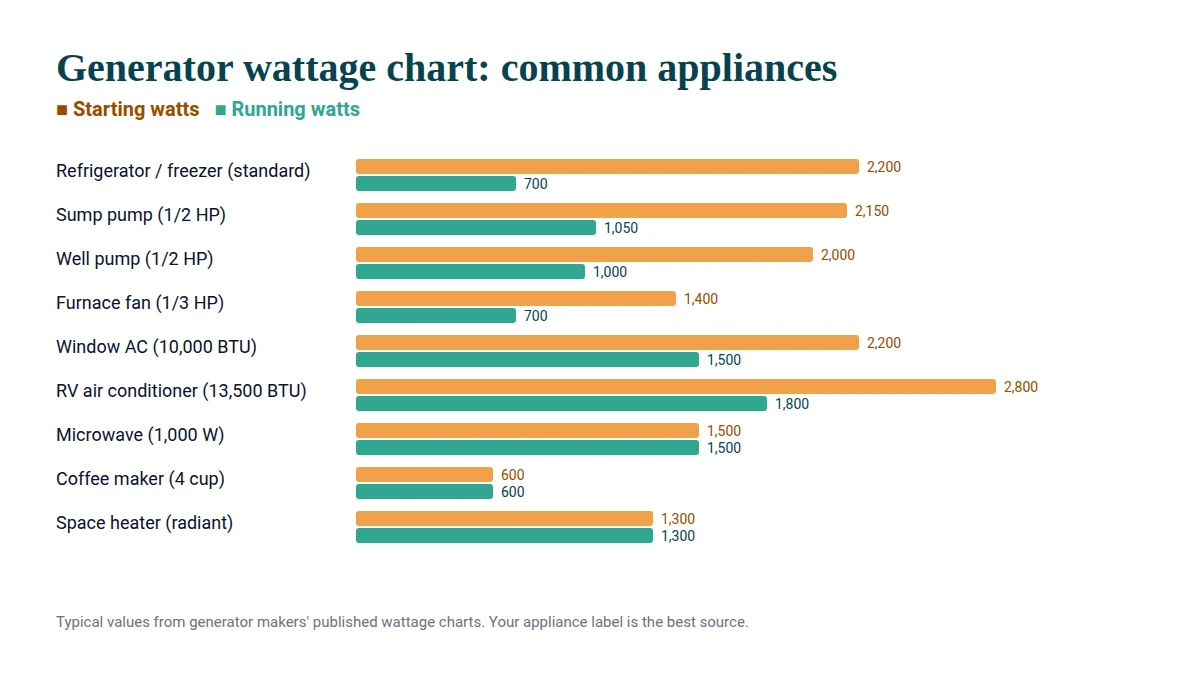
Typical running and starting watts for common appliances. The figures are typical values from generator makers’ published wattage charts. The last column links to a typical model of each appliance on Amazon, so you can compare wattages. Your appliance’s label or manual is always more accurate, so use it when you have it.
Kitchen
| Appliance | Running watts | Starting watts | Notes | Typical appliance |
|---|---|---|---|---|
| Refrigerator / freezer (standard) | 700 | 2,200 | Standard 18 cu ft top-freezer fridge | |
| Refrigerator / freezer (Energy Star) | 192 | 1,200 | Energy Star top-freezer fridge | |
| Microwave (650 W) | 1,000 | 1,000 | Occasional use | Compact 650 W microwave |
| Microwave (800 W) | 1,300 | 1,300 | Occasional use | 800 W countertop microwave |
| Microwave (1,000 W) | 1,500 | 1,500 | Occasional use | 1,000 W countertop microwave |
| Coffee maker (4 cup) | 600 | 600 | Occasional use | 4-cup drip coffee maker |
| Toaster | 850 | 850 | Occasional use | 2-slice toaster |
| Blender | 400 | 850 | Occasional use | Countertop blender |
| Electric fry pan | 1,500 | 1,500 | Occasional use | 12 in electric skillet |
| Slow cooker | 270 | 270 | 6 qt slow cooker | |
| Hot plate | 2,500 | 2,500 | Occasional use | Double-burner electric hot plate |
| Electric range (one 8" element) | 2,100 | 2,100 | 240 V | Electric range (30 in) |
| Dishwasher (cool dry) | 216 | 540 | 24 in built-in dishwasher |
Water
| Appliance | Running watts | Starting watts | Notes | Typical appliance |
|---|---|---|---|---|
| Sump pump (1/3 HP) | 800 | 1,300 | Usually hardwired | 1/3 HP submersible sump pump |
| Sump pump (1/2 HP) | 1,050 | 2,150 | Usually hardwired | 1/2 HP submersible sump pump |
| Well pump (1/3 HP) | 1,000 | 2,200 | Usually hardwired | 1/3 HP shallow well jet pump |
| Well pump (1/2 HP) | 1,000 | 2,000 | Usually hardwired | 1/2 HP shallow well jet pump |
| Electric water heater | 4,500 | 4,500 | 240 V | 40 gal electric water heater |
Heating & cooling
| Appliance | Running watts | Starting watts | Notes | Typical appliance |
|---|---|---|---|---|
| Furnace fan (1/4 HP) | 600 | 1,000 | Usually hardwired | 1/4 HP furnace blower motor |
| Furnace fan (1/3 HP) | 700 | 1,400 | Usually hardwired | 1/3 HP furnace blower motor |
| Furnace fan (1/2 HP) | 875 | 2,350 | Usually hardwired | 1/2 HP furnace blower motor |
| Space heater (radiant) | 1,300 | 1,300 | 1,500 W radiant space heater | |
| Window AC (10,000 BTU) | 1,500 | 2,200 | 10,000 BTU window air conditioner | |
| Central AC (10,000 BTU) | 1,500 | 4,500 | 240 V | Central AC condenser (about 1 ton) |
| Box fan (20") | 200 | 200 | 20 in box fan | |
| Portable fan | 40 | 120 | Desk or portable fan | |
| Humidifier (13 gal) | 175 | 175 | Whole-room humidifier |
Laundry
| Appliance | Running watts | Starting watts | Notes | Typical appliance |
|---|---|---|---|---|
| Washing machine | 1,200 | 1,200 | Occasional use | Top-load washing machine |
| Clothes dryer (electric) | 5,400 | 6,750 | 240 V, Occasional use | Electric clothes dryer (240 V) |
| Clothes dryer (gas) | 700 | 1,800 | Occasional use | Gas clothes dryer |
| Iron | 1,200 | 1,200 | Occasional use | Steam iron |
Living
| Appliance | Running watts | Starting watts | Notes | Typical appliance |
|---|---|---|---|---|
| Light bulb (edit to your bulb) | 60 | 60 | LED or incandescent bulb | |
| TV (flat screen, 46") | 190 | 190 | 46 to 50 in LED TV | |
| Laptop | 250 | 250 | Laptop with charger | |
| Desktop computer | 800 | 800 | Desktop computer | |
| Computer monitor (LCD) | 30 | 30 | 24 in LCD monitor | |
| Printer | 600 | 600 | Occasional use | Home laser printer |
| Phone charger | 25 | 25 | USB phone charger | |
| Radio | 200 | 200 | Portable radio | |
| Hair dryer (1,600 W) | 1,800 | 1,900 | Occasional use | 1,600 W hair dryer |
| Garage door opener | 720 | 1,420 | Occasional use | 1/2 HP garage door opener |
RV
| Appliance | Running watts | Starting watts | Notes | Typical appliance |
|---|---|---|---|---|
| RV air conditioner (11,000 BTU) | 1,010 | 1,600 | 11,000 BTU RV rooftop AC | |
| RV air conditioner (13,500 BTU) | 1,800 | 2,800 | 13,500 BTU RV rooftop AC | |
| RV air conditioner (15,000 BTU) | 2,000 | 3,300 | 15,000 BTU RV rooftop AC | |
| RV refrigerator | 180 | 600 | RV refrigerator |
Workshop
| Appliance | Running watts | Starting watts | Notes | Typical appliance |
|---|---|---|---|---|
| Electric drill (1/2") | 600 | 900 | 1/2 in corded drill | |
| Circular saw (7-1/4") | 1,400 | 2,300 | 7-1/4 in corded circular saw | |
| Table saw (10") | 1,800 | 4,500 | 10 in table saw | |
| Air compressor (1 HP) | 1,600 | 4,500 | 1 HP air compressor | |
| Pressure washer (1 HP) | 1,200 | 3,600 | Electric pressure washer | |
| Electric grill (tabletop) | 1,650 | 1,650 | Tabletop electric grill |
Starting watts are the total watts drawn for a few seconds at start-up. Values are typical estimates from generator makers' published wattage charts; check your appliance label. If it only lists amps, watts = amps × volts (usually 120 V). Typical-appliance links go to Amazon.
How to Use a Smaller Generator
- Start the biggest motor first, on its own, then add other loads one at a time.
- Switch off occasional items, like the microwave or coffee maker, while a pump or fridge is starting.
- Pick efficient appliances. An Energy Star fridge can start on about half the watts of an older model.
- Ask an HVAC technician about a soft starter for an air conditioner. It can cut the starting surge a lot.
- For small loads, an inverter and battery may be enough. See our guide to using your car and a power inverter for backup.
Generator Safety Basics
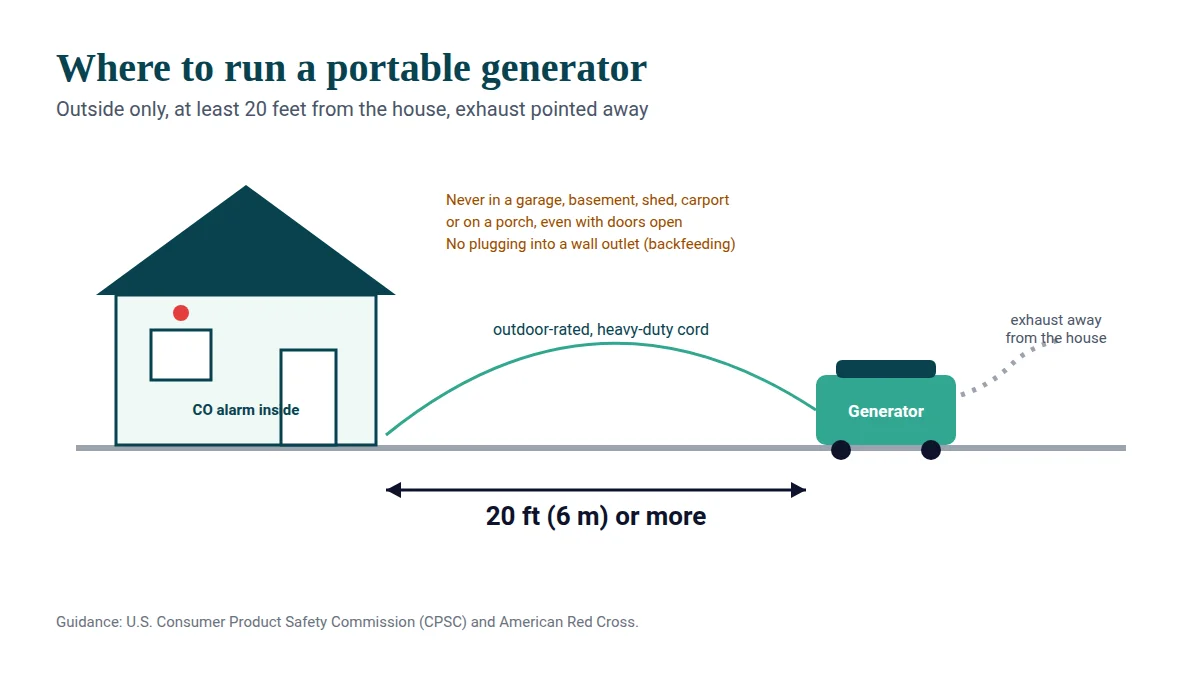
Carbon monoxide from generators kills people every year. The U.S. Consumer Product Safety Commission and the American Red Cross give the same core advice:
- Run a portable generator outside only, at least 20 feet from the house, with the exhaust pointed away from doors, windows and vents.
- Never run it in a home, garage, basement, crawlspace, shed, carport or on a porch, even with the doors open.
- Install battery-powered carbon monoxide alarms on every level of your home. If one sounds, get outside and call 911.
- Never plug a generator into a wall outlet. This is called backfeeding and can kill utility workers and neighbors. Use a transfer switch or interlock kit installed by a licensed electrician.
- Use heavy-duty, outdoor-rated cords that are rated for the load, and keep the generator dry.
- Turn the generator off and let it cool before refueling. OSHA’s generator fact sheet covers more hazards.
Planning a full backup setup with batteries and solar as well? Read our guide to setting up a reliable off-grid backup system.
Frequently Asked Questions About Generator Wattage Calculator
What size generator do I need to run a house?
For essentials only (fridge, sump pump, furnace fan, lights, TV and a microwave), most homes need about 5,000 to 7,500 running watts. Running central air, an electric water heater or an electric dryer needs a much bigger generator, often 10,000 W or more and a 240 V outlet. Use the calculator with your own appliances for a better number.
Should I size a generator by running watts or starting watts?
Check both. The generator’s starting watts must cover your continuous loads plus the biggest motor starting, and its running watts must cover what runs at the same time with some headroom. A generator that meets only one of the two numbers will struggle.
Why does the calculator use an 80% load limit?
Running a generator at or below 80% of its rated output leaves room for small surges and keeps the engine from working flat out for hours. You can change the load limit in the calculator’s settings, from 50% to 100%.
Will a 3,500 watt generator run a refrigerator?
Yes. A standard fridge needs about 700 W to run and about 2,200 W to start, so a 3,500 W generator can run it with room for lights, chargers and a TV. Start the fridge before switching on other large loads.
How accurate is a generator wattage calculator?
It is an estimate. The wattages are typical values from generator makers’ published wattage charts, and real appliances vary with age, size and model. Use the numbers on your appliance labels where you can, and size up a little if you are between two generator sizes.
Can I plug my generator into a wall outlet?
No. Backfeeding a house through an outlet is illegal in many places and can electrocute utility workers and neighbors. To power hardwired items such as a furnace or well pump, have a licensed electrician install a transfer switch or interlock kit.
Get our newest articles every week
One short email a week with our newest self-reliance and off-grid articles. Free, and you can unsubscribe at any time.
We use Mailchimp to send this email. See our privacy policy.